Dear Friends,
This is my eighth post of direct commentary on How Jesus Became God, by Bart Ehrman. Check here for my introductory comments.
Open series outline: Going for the jugular- Intro post #1: Kickoff
- Intro post #2: Christ myth theory
- Intro post #3: Internet Infidels
- Habermas & Licona, Introduction, Post #1: Meet Gary
- Habermas & Licona, Introduction, Post #2: Meet Michael
- Habermas & Licona, Introduction, Post #3: They Saw Something
- Habermas & Licona, Part 1, Post #4: The Shockwave
- Habermas & Licona Part 1, Post #5: Saved From What?
- Habermas & Licona Part 1, Post #6: Jesus Claimed He Would Rise Again
- Habermas & Licona Part 1, Post #7: Why It's Going For The Jugular
- Habermas & Licona Part 1, Post #8: Washington Myth Theory
- Habermas & Licona Part 1, Post #9: History 101
- Habermas & Licona Part 2, Post #10: Our First Minimal Fact!
- Habermas & Licona Part 2, Post #11: Rumors Of The Bible's Obscurity Have Been Greatly Exaggerated
- Habermas & Licona Part 2, Post #12: If Your Mother Tells You She Loves You, Check It Out
- Habermas & Licona Part 2, Post #13: No, The Gospels Were Not Written Hundreds Of Years Later
- Habermas & Licona Part 2, Post #14: Clement Of Rome
- Habermas & Licona Part 2, Post #15: Polycarp
- Habermas & Licona Part 2, Post #16: The Seal of Blood
- Habermas & Licona Part 2, Post #17: The Seal of More Blood
- Habermas & Licona Part 2, Post #18: Meet The Scholars
- Habermas & Licona Part 2, Post #19: It was right under my nose
- Habermas & Licona Part 2, Post #20: Oh, so my brother really IS God
- Habermas & Licona Part 2, Post #21: My knees are shaking
- Habermas & Licona Part 2, Post #22: The Bible: It's not just for Christians anymore!
- Habermas & Licona Part 3, Post #23: Kicking the tires
- Habermas & Licona Part 4, Post #24: All together now?
- Habermas & Licona Part 4, Post #25: A red herring
- Habermas & Licona Part 4, Post #26: Moses the friendly ghost
- Habermas & Licona Part 4, Post #27: Consider the source
- Habermas & Licona Part 4, Post #28: Parthian shots
- Habermas & Licona Part 4, Post #29: We’re taking strange fire! Part 1
- Habermas & Licona Part 4, Post #30: We’re taking strange fire! Part 2
- Habermas & Licona Part 4, Post #31: We’re taking strange fire! Part 3
- Habermas & Licona Part 4, Post #32: Suspicious Minds
- Habermas & Licona Part 4, Post #33: Alien vs. Jesus
- Habermas & Licona Part 4, Post #34: A position statement disguised as an argument
- Into the woods...and the Way back home
- Yes, Jesus went there
- Ehrman, Post #1: Make this shot count
- Ehrman, Post #2: Everyone was dead
- Ehrman, Post #3: It's almost like monotheism is the logical choice
- Ehrman, Post #4: Admit you never saw a vulture rising from the flames or die
- Ehrman, Post #5: Is God going to melt like wax?
- Ehrman, Post #6: Less Hercules, more keeping up with the Joneses
- Ehrman, Post #7: Did Enoch unlock God mode?
- Ehrman, Post #8: It is just Me
- Ehrman, Post #9: Dodge City or New Jerusalem?
- Ehrman, Post #10: Was Jesus an angel with +5 awesomeness?
- Ehrman, Post #11: The evidence that never showed up
- Ehrman, Post #12: Unsourced + Uncited = Unprecedented
- Ehrman, Post #13: Only a billion feet to go
- Ehrman, Post #14: Princeton vs. Oxford Smackdown
- Ehrman, Post #15: This is starting to get easier…
.
As I’m delving deeper into Ehrman’s claims that humans become gods and vice versa in the Bible, I’m beginning to zero in on his MO: Take each passage in the most literal possible way, and then use the resulting theological rat’s nest to discredit the Bible. We saw this in his discussion of the ten commandments, and I think we’ll see it again today.
When God calls you on the carpet
The passage in question today is Psalm 82…it’s not that long, so I’ll paste the whole thing below. I’ll capitalize “gods”, since that’s the term our discussion centers around.
[Psa 82:1-8 KJV] 1 [[A Psalm of Asaph.]] God standeth in the congregation of the mighty; he judgeth among the GODS. 2 How long will ye judge unjustly, and accept the persons of the wicked? Selah. 3 Defend the poor and fatherless: do justice to the afflicted and needy. 4 Deliver the poor and needy: rid [them] out of the hand of the wicked. 5 They know not, neither will they understand; they walk on in darkness: all the foundations of the earth are out of course. 6 I have said, Ye [are] GODS; and all of you [are] children of the most High. 7 But ye shall die like men, and fall like one of the princes. 8 Arise, O God, judge the earth: for thou shalt inherit all nations.
According to Ehrman, the “gods” in this passage are “angelic beings” who had been given authority over humanity. God is displeased with their performance and takes away their immortality (48 of 302).
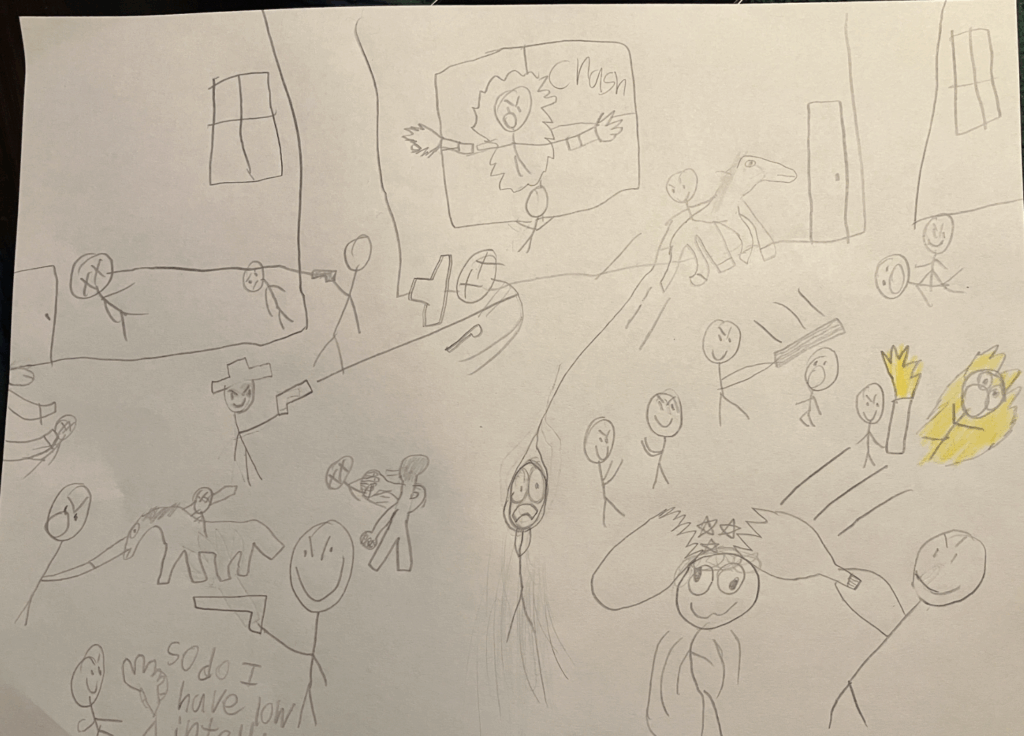
If the theological statements in various Bible passages were residents of a city, would it be more like Dodge City or New Jerusalem?
Ehrman’s broader point, as I’ve discussed earlier, is that the Old Testament itself presents us with kind of a Wild West of angels becoming God, humans becoming angels, angels becoming human, humans becoming God and (thanks to that old stick in the mud sheriff, Isaiah) rigid monotheism. In turn, that hodge-podge of conflicting passages is the lens through which we’re supposed to interpret the earliest Christians’ claims about Jesus.
So, as we did with the ten commandments, let’s analyze the theology of Psalm 82 and see if it’s more like Dodge City, with its bloody shootouts, or New Jerusalem, that beautiful place of harmony described in Revelation 21-22.
This one took some digging! But it was totally worth it.
So, does “gods” in Psalm 82 actually refer to angelic/divine beings, rather than mortal men?
Not likely.
If we use the very reasonable approach of letting the Bible be its own interpreter, we can see that “gods” in Psalm 82 is merely a figurative reference to human judges.
To begin with, the Hebrew word for “gods” in Psalm 82 is‘ĕlōhîm…the same word underlying “God” in Genesis 1:1:
[Gen 1:1 KJV] 1 In the beginning God created the heaven and the earth.
Going just on that information, it’s easy to think that Psalm 82 really is referring to some type of deity. But if we really want to understand what Asaph is talking about here, we’re going to have to dig just a BIT deeper.
My parallel passage…
Namely, we need to look at Exodus 22 at this point, because it has two very important parallels with Psalm 82:
- Translates ĕlōhîm as “gods”
- Psalm 82: verses 1, 6 (see above)
- Exodus 22:28: Thou shalt not revile the GODS, nor curse the ruler of thy people.
- Discusses these beings, whatever they are, as some sort of judges
- Psalm 82: verse 2 (see above)
- Exodus 22 translates ‘ĕlōhîm as “judges” 3 times prior to translating it as “gods” in verse 28
- Exodus 22:8-9: If the thief be not found, then the master of the house shall be brought unto the JUDGES, [to see] whether he have put his hand unto his neighbour’s goods. 9 For all manner of trespass, [whether it be] for ox, for ass, for sheep, for raiment, [or] for any manner of lost thing, which [another] challengeth to be his, the cause of both parties shall come before the JUDGES; [and] whom the JUDGES shall condemn, he shall pay double unto his neighbour.
So, because of those strong parallels, I submit that we just need to figure out whether the judges in Exodus 22 are humans or “angelic beings”. It should be obvious, but better safe than sorry, right?
So, are the judges in Exodus 22 angels or humans?
Just rewind 4 chapters:
[Exo 18:21-22 KJV] 21 Moreover thou shalt provide out of all the people able MEN, such as fear God, men of truth, hating covetousness; and place [such] over them, [to be] rulers of thousands, [and] rulers of hundreds, rulers of fifties, and rulers of tens: 22 And let them JUDGE the people at all seasons: and it shall be, [that] every great matter they shall bring unto thee, but every small matter they shall judge: so shall it be easier for thyself, and they shall bear [the burden] with thee.
That seems pretty conclusive to me. The judges/”gods” in Exodus 22…and in Psalm 82…are humans.
And as a side note for WHY they would be referred to as gods (not original to me, BTW…I think it was John Gill), I appeal to Romans 13, which says that the powers that be are ordained of God. So, calling them “gods” is just a reference to the fact that they have been given authority by God and are supposed to represent Him, to some extent, on earth.
Yet another time ‘ĕlōhîm obviously did not refer to an angelic being
But I don’t need to rely solely on Exodus 22 for my understanding of Psalm 82; Exodus 7:1 is another important parallel.
[Exo 7:1 KJV] 1 And the LORD said unto Moses, See, I have made thee a god to Pharaoh: and Aaron thy brother shall be thy prophet.
Here God is talking about the special role that Moses has been given as God’s ambassador to Pharaoh; God is NOT saying that Moses has now ascended to some higher plane of existence. My evidence? In the same book, 25 chapters later, God confirms that Moses is STILL a man, with all the limitations and vulnerabilities thereunto appertaining:
[Exo 33:20 KJV] 20 And he said, Thou canst not see my face: for there shall no MAN see me, and live.
So, again, I think it should be clear that Exodus 7:1 is figurative. It does not mean that Moses can fly around, has obtained the immortality gamepass, or can survive the sight of God’s full glory unveiled.
“Divine council”? ABOUT that…
Part of Ehrman’s reason for thinking that God is talking to a divine council of angels is that the NRSV literally mentions a “divine council” in verse 1:
God has taken his place in the divine council; in the midst of the gods he holds judgment:
As you may recall, the KJV calls it “the congregation of the mighty”. So, which translation is right?
It’s a bit of an intimidating question, since I’m not a Hebrew scholar; but after some digging into the KJV vs. the NRSV translations of this verse, I believe I encountered some good reasons to be skeptical of the NRSV rendering.
Namely, Psalm 82:1 is the ONLY place in the whole Old Testament where the NRSV translates H410 (‘ēl) as “divine”, and is the ONLY place in the whole Old Testament where H5712 (ʿēḏâ) is translated as “council”. By contrast, the KJV translates H410 as “mighty” and “might” a combined 6 times, and translates H5712 as “congregation” 124 times. I obtained this information from blueletterbible.org, biblestudytools.com, and Chatgpt.
In other words, “divine council” seems like more of a commentary on the rest of the Psalm, rather than a straight translation. As such, I don’t think it’s appropriate to use the words “divine council” as part of an argument for angels being called God or becoming human.
Ehrman’s parallel passage
This blog post would not be complete without considering Dr. Ehrman’s use of Job 1:6 as a parallel passage:
[Job 1:6 KJV] 6 Now there was a day when the sons of God came to present themselves before the LORD, and Satan came also among them.
(I am simply citing the KJV here because Ehrman cites the verse as saying “sons of God”, just like the KJV (but, interestingly, unlike the NRSV, which is his preferred translation))
Ehrman says that this passage, like Psalm 82, is talking about God’s interaction with a divine council.
Now I will grant that I always thought, as Ehrman does, that this verse is talking about angels. But a friend at church presented a counterargument that I thought was pretty convincing. I’ll bulletize it below for brevity, but my point is that the ball is in the court of the “divine council” faction to better explain why Job 1:6 is talking about angels…especially since Ehrman himself translates Job 1:6 using “sons of God” rather than “divine council”.
Here’s the argument for understanding the “sons of God” in Job 1:6 as a worshipping community of humans, rather than angels:
- “Sons of God” refers to humans in Genesis 6, as I argued here (1)
- Another example of humans in the OT explicitly being referred to as God’s “children”: [Deu 14:1 KJV] 1 Ye [are] the children of the LORD your God: ye shall not cut yourselves, nor make any baldness between your eyes for the dead.
- Though “sons of God” in Job 38:7…
- Job 38:7 When the morning stars sang together, and all the sons of God shouted for joy?
- …is usually thought to refer to angels, I think it’s just as if not more defensible to interpret it as stars; in conjunction with the first part of the verse, this is an example of parallelism, which is common in Hebrew poetry
- James 1:17 provides a parallel passage for God as the father of the stars: Every good gift and every perfect gift is from above, and cometh down from the FATHER OF LIGHTS, with whom is no variableness, neither shadow of turning
- Satan is called “the accuser of our brethren” in Revelation 12:10, which dovetails nicely with his appearance among the sons of God in Job 1:6 and his subsequent indictment of Job
A reminder or a sentence?
Finally, Ehrman asserts that Psalm 82:6-7…
[Psa 82:6-7 KJV] 6 I have said, Ye [are] gods; and all of you [are] children of the most High. 7 But ye shall die like men, and fall like one of the princes.
…is God’s sentence on the corrupt angelic judges He has been rebuking. He “makes them mortal, so that they will die and cease to exist.”
I already talked about “gods” higher up, but for “children of the most High”, I will once again refer to [Deu 14:1 KJV] 1 Ye [are] the children of the LORD your God: ye shall not cut yourselves, nor make any baldness between your eyes for the dead. as a clear OT example of humans being called children of God.
So, verse 7 could simply be a reminder to the corrupt human judges that, even though God has given them authority and an exalted position, they are still mortal.
In other words, the interpretation of verse 7 is going to be driven by what you did with verse 1 and verse 6.
So, judge for yourself…which one of us has stronger support for our interpretation of Psalm 82 verses 1 and 6 from elsewhere in the Old Testament?
Dodge City or New Jerusalem?
The way Ehrman reads it, the Old Testament is (when you boil away the flowery language and feel-good maxims) a war zone, sort of a theological version of Dodge City…and in light of all that discord between the various Biblical writers, should not be taken as the authoritative word of God. On top of that, the Old Testament gives us, per Ehrman, license to reinterpret early Christianity as “flesh made God” rather than “God made flesh”. Today, as we have seen before, Ehrman tries to back up his view of the Old Testament by reading verses in the most literal way possible (such as “gods” in Psalm 82).
In examining Psalm 82, I tried to let the Bible be its own interpreter. I tried to show how the more concrete parallel passages give us insight into the more difficult ones. I tried to show that there really is harmony in the ideas of the various Old Testament writers, if you compare them carefully. The theological ideas presented in the Old Testament are not having a shootout with each other…they are coexisting peacefully like the inhabitants of New Jerusalem.
In summary: Psalm 82 is talking about corrupt human judges, not angels being called “gods” and then losing their immortality. Therefore, Psalm 82 does not add, however incrementally, to Ehrman’s justification for reinterpreting early Christianity.
Jesus is God made flesh, not flesh made God!
God bless,
TFOTF
**************************************************************************************************
CONTACT INFORMATION
Mailing list / Email:
If you want to be notified when there is a new post, just email me at gmail.com with subscribe in the subject. There will be a new post every week or so. What’s my gmail username? Good question, it is theformofthefourth. If you don’t want to subscribe but still want to contact me, please feel free!
Comments:
Comments are super easy! Most comments will immediately be posted. You can use a fake email address and name if you want, I don't mind at all. I just want to hear from you 🙂
RSS:
On the side of the screen (or the bottom, depending on what device you're using), look for the "Meta" heading. Under that heading, there is one link for the entries feed (meaning, all my blog posts), and another link for the comments feed. Tap the one you want, and then use an app like flipboard or podcast addict to subscribe. I don't know about all the choices out there, but I use Podcast Addict to keep a steady stream of audio podcasts and blog posts flowing into my phone.
Substack:
My attempts at creative writing are on Substack, under the pen name Doug Clapek.