
The New York Public Library comes to the rescue in today’s post!
Dear Friends,
This is my thirteenth post of direct commentary on How Jesus Became God, by Dr. Bart Ehrman. Check here for my introductory comments.
Open series outline: Going for the jugular- Intro post #1: Kickoff
- Intro post #2: Christ myth theory
- Intro post #3: Internet Infidels
- Habermas & Licona, Introduction, Post #1: Meet Gary
- Habermas & Licona, Introduction, Post #2: Meet Michael
- Habermas & Licona, Introduction, Post #3: They Saw Something
- Habermas & Licona, Part 1, Post #4: The Shockwave
- Habermas & Licona Part 1, Post #5: Saved From What?
- Habermas & Licona Part 1, Post #6: Jesus Claimed He Would Rise Again
- Habermas & Licona Part 1, Post #7: Why It's Going For The Jugular
- Habermas & Licona Part 1, Post #8: Washington Myth Theory
- Habermas & Licona Part 1, Post #9: History 101
- Habermas & Licona Part 2, Post #10: Our First Minimal Fact!
- Habermas & Licona Part 2, Post #11: Rumors Of The Bible's Obscurity Have Been Greatly Exaggerated
- Habermas & Licona Part 2, Post #12: If Your Mother Tells You She Loves You, Check It Out
- Habermas & Licona Part 2, Post #13: No, The Gospels Were Not Written Hundreds Of Years Later
- Habermas & Licona Part 2, Post #14: Clement Of Rome
- Habermas & Licona Part 2, Post #15: Polycarp
- Habermas & Licona Part 2, Post #16: The Seal of Blood
- Habermas & Licona Part 2, Post #17: The Seal of More Blood
- Habermas & Licona Part 2, Post #18: Meet The Scholars
- Habermas & Licona Part 2, Post #19: It was right under my nose
- Habermas & Licona Part 2, Post #20: Oh, so my brother really IS God
- Habermas & Licona Part 2, Post #21: My knees are shaking
- Habermas & Licona Part 2, Post #22: The Bible: It's not just for Christians anymore!
- Habermas & Licona Part 3, Post #23: Kicking the tires
- Habermas & Licona Part 4, Post #24: All together now?
- Habermas & Licona Part 4, Post #25: A red herring
- Habermas & Licona Part 4, Post #26: Moses the friendly ghost
- Habermas & Licona Part 4, Post #27: Consider the source
- Habermas & Licona Part 4, Post #28: Parthian shots
- Habermas & Licona Part 4, Post #29: We’re taking strange fire! Part 1
- Habermas & Licona Part 4, Post #30: We’re taking strange fire! Part 2
- Habermas & Licona Part 4, Post #31: We’re taking strange fire! Part 3
- Habermas & Licona Part 4, Post #32: Suspicious Minds
- Habermas & Licona Part 4, Post #33: Alien vs. Jesus
- Habermas & Licona Part 4, Post #34: A position statement disguised as an argument
- Into the woods...and the Way back home
- Yes, Jesus went there
- Ehrman, Post #1: Make this shot count
- Ehrman, Post #2: Everyone was dead
- Ehrman, Post #3: It's almost like monotheism is the logical choice
- Ehrman, Post #4: Admit you never saw a vulture rising from the flames or die
- Ehrman, Post #5: Is God going to melt like wax?
- Ehrman, Post #6: Less Hercules, more keeping up with the Joneses
- Ehrman, Post #7: Did Enoch unlock God mode?
- Ehrman, Post #8: It is just Me
- Ehrman, Post #9: Dodge City or New Jerusalem?
- Ehrman, Post #10: Was Jesus an angel with +5 awesomeness?
- Ehrman, Post #11: The evidence that never showed up
- Ehrman, Post #12: Unsourced + Uncited = Unprecedented
- Ehrman, Post #13: Only a billion feet to go
- Ehrman, Post #14: Princeton vs. Oxford Smackdown
.
Dr. Ehrman’s chosen text today is more respectable than the others he’s been using lately…but the translation he uses, and his exegesis thereof, leave me with more questions than answers.
Sirach: Finally, a decent pedigree!
The book of Sirach (AKA Ecclesiasticus), written around 180 BC (1), is yet another non-canonical book that Ehrman is using to try to chip away at Christianity.
However, unlike the other non-canonical books Ehrman has been referencing in earlier pages, Sirach has actually been pretty well preserved, and IS in fact considered canonical by Catholics and a few other denominations (but not Protestants or Jews) (1).
So, unlike in my other recent posts, I’m going to accept that the text Ehrman is appealing to was in fact influential in the Jewish circles that Paul and other early Christians traveled in (1).
So why is Dr. Ehrman specifically interested in Sirach?
Because Ehrman thinks this book shows that Jesus’s Jewish contemporaries believed humans could become angels. By appealing to Sirach and other books, Ehrman is building a cumulative case that early Christians simply believed that Jesus was an angel in human form.
Here’s a quote (50 of 302):
“And so, for example, in the apocryphal book of Sirach we learn that God made Moses ‘equal in glory to the holy ones, and made him great, to the terror of his enemies’ (45.1-5). He thus is equal to the angels.”
Open shut case, right?
A new challenger rises
I was in New York on a business trip recently, and used a few hours of personal time to sneak into the New York Public Library. Yes, that library!
They actually steer tourists away from rooms with actual bookstacks, but nevertheless, I talked my way into the Dorot Jewish Division reading room. And what did my wondering eyes behold but this awesome book about the Jewish apocrypha, written by an Oxford scholar!
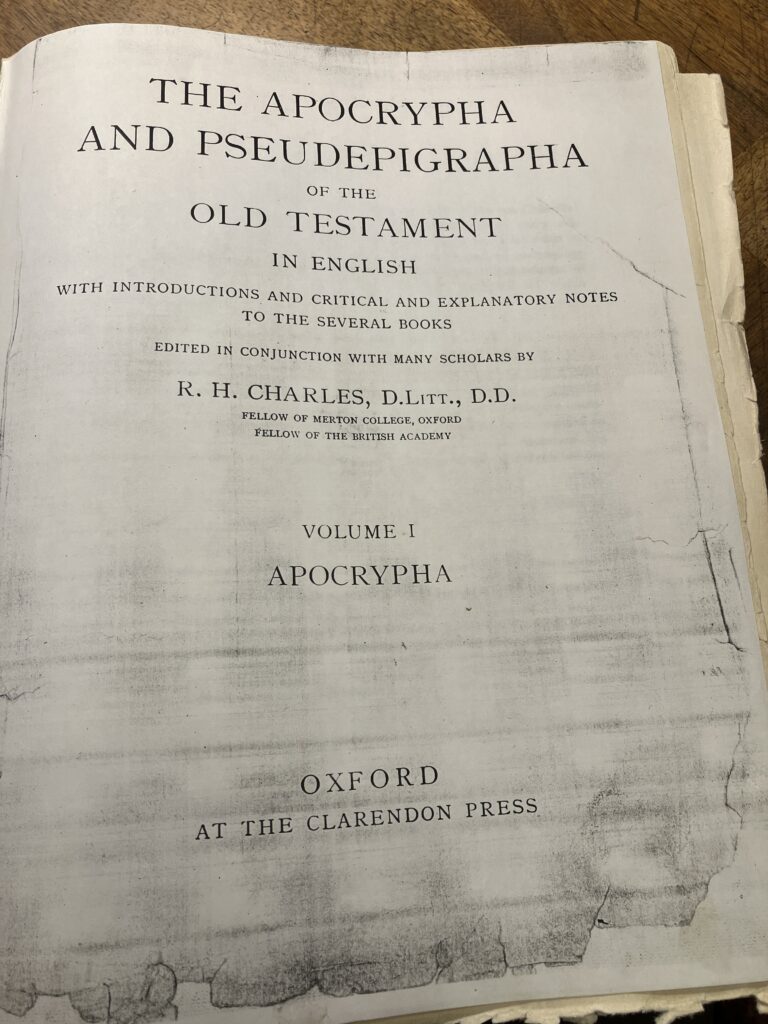
“This could be juicy!” I thought, as my greedy hands pulled it off the shelf and cracked it open on the table.
When I finally found the relevant passage of the Sirach, I was fascinated to learn that neither the translation, not the interpretation thereof, matched with Ehrman. And the difference isn’t trivial.
Here is the translation of Sirach 45:2-3:
“And <He made him glorious as> God, And mighty in awe-inspiring deeds. By his words he brought <signs> swiftly to pass, And he emboldened him in the presence of the king.”
And here is the footnote on the verbiage in question:

And that was something completely different
So, in this translation, there’s no hint of Moses being made equal in glory to holy ones. Instead, he is made “glorious as God”. You might think that verbiage makes Ehrman’s case even stronger, since now the comparison is to God Himself instead of to the Holy Ones…but it doesn’t say “as glorious as God”, merely “glorious as God”. The former would mean Moses’s glory is now equal to God’s, while the latter just means that Moses’s glory is now on the same scale as God’s, if not actually equal.
But I think the differing interpretation is even more important than the differing translations. Our Oxford friend doesn’t read this passage as a comment about Moses’s afterlife at all. Instead, he simply points back to two passages from Exodus which have nothing to do with the afterlife and everything to do with Moses’s mission to bring God’s people out of Egypt:
[Exo 4:16 KJV] 16 And he shall be thy spokesman unto the people: and he shall be, [even] he shall be to thee instead of a mouth, and thou shalt be to him instead of God.
[Exo 7:1 KJV] 1 And the LORD said unto Moses, See, I have made thee a god to Pharaoh: and Aaron thy brother shall be thy prophet.
Uh oh. The Princeton guy differs from the Oxford guy.
So, what are we to do?
Checking for bias doesn’t help much; the Oxford guy (a clergyman, per Wikipedia) and the Princeton guy (an atheist) are both taking the sides you would expect them to take, given their biases.
Diving directly into the translation question would be awesome, but it’s honestly a little intimidating to contemplate settling translation differences between two elite professors. Doable, but…it feels like a rabbit hole.
However, as I argued in Ehrman, Post #9 (see linked outline at the top of this post), commentaries can sometimes masquerade as translations. And I think that awareness can help us make sense of the current disagreement.
Which Sirach interpretation would Sirach endorse?
In other words, to try to untangle this conundrum, I’m going to treat the Sirach translation, AND the commentary thereon, as a package deal, and try to figure out which package better conforms to the Pentateuch (the 5 books of Moses). The reason I think this approach is valid is because Sirach himself clearly had a high respect for Moses’s writings. From what I’ve read of Sirach, there’s no hint of someone who wants to radically reinterpret Moses.
Through this lens, it’s clear that the Oxford guy has the more defensible reading.
Unlike Ehrman, who cites ZERO Old Testament passages to support his reading of Sirach, Charles cites two passages from Exodus that relate to the Sirach passage in question.
Unlike Ehrman’s reading, Charles’s reading of the Sirach passage does not introduce some new event in Moses’s life which was never spoken of in the Old Testament canon. Instead, Charles’s reading simply points back to two canonical passages about the life of Moses.
The one that ties it all together
Furthermore, Charles’s reading and Ehrman’s reading BOTH tie into the following passage from Deuteronomy…a passage that, again, clearly has nothing to do with the afterlife. I’m going to capitalize some words to make the connection more obvious:
[Deu 34:10-12 KJV] 10 And there arose not a prophet since in Israel like unto Moses, whom the LORD knew face to face, 11 In all the SIGNS and the wonders, which the LORD sent him to do in the land of Egypt to Pharaoh, and to all his servants, and to all his land, 12 And in all that MIGHTY hand, and in all the great TERROR which Moses shewed in the sight of all Israel.
Did you see them? SIGNS and MIGHTY tie back to Charles’s translation, and TERROR ties back to Ehrman’s translation.
So, while fully acknowledging my own bias, I’m awarding Dr. Charles the TKO here. Sirach does not say that Moses became an angel, and therefore provides no support to Dr. Ehrman’s claim that early Christians believed Jesus was just an angel in human form.
What do you think?
God bless,
TFOTF
Links:
God bless,
TFOTF
**************************************************************************************************CONTACT INFORMATION
Mailing list / Email:
If you want to be notified when there is a new post, just email me at gmail.com with subscribe in the subject. There will be a new post every week or so. What’s my gmail username? Good question, it is theformofthefourth. If you don’t want to subscribe but still want to contact me, please feel free!
Comments:
Comments are super easy! Most comments will immediately be posted. You can use a fake email address and name if you want, I don't mind at all. I just want to hear from you 🙂
RSS:
On the side of the screen (or the bottom, depending on what device you're using), look for the "Meta" heading. Under that heading, there is one link for the entries feed (meaning, all my blog posts), and another link for the comments feed. Tap the one you want, and then use an app like flipboard or podcast addict to subscribe. I don't know about all the choices out there, but I use Podcast Addict to keep a steady stream of audio podcasts and blog posts flowing into my phone.
Substack:
My attempts at creative writing are on Substack, under the pen name Doug Clapek.